
The book
Phase Differential Theory
A Relational Framework for Quantum Mechanics, Gravity and Cosmology
Graham Fincham
What persists, what changes, and what becomes real.
About the book
Nine parts, seventy-two chapters.
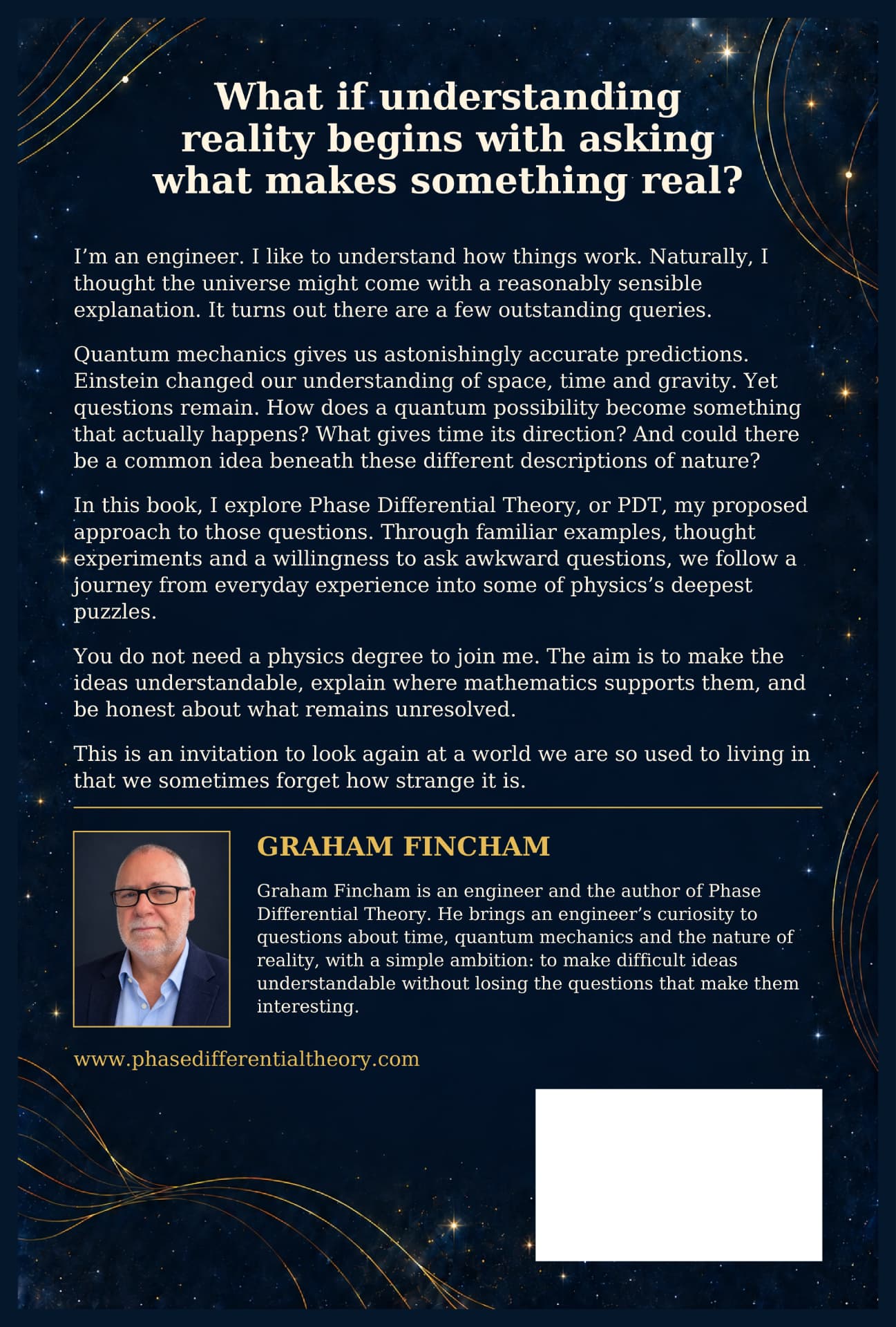
Across 72 chapters in nine parts, Graham Fincham develops the ideas behind Phase Differential Theory: a proposed account of physical reality built around relational phase, the persistence of structure, and the formation of events.
Every chapter has a summary below. Chapters 1 to 7 can be read in full as PDFs and heard in full as audiobook recordings. Each chapter also has a short introduction film, which is a summary rather than the full text. The complete book is coming soon.
Why read the book?
A continuous narrative through the research programme.
The published papers are written as independent scientific publications. Each develops a specific part of the research programme and therefore includes the background, assumptions, mathematical development, and technical detail needed to stand on its own.
The book takes a different approach.
Rather than reading individual papers in isolation, readers follow the development of the framework as one continuous narrative, allowing the central ideas to build naturally from chapter to chapter.
Mathematical derivations and technical discussions are included where appropriate, while the main text focuses on developing intuition, context, and the overall structure of the theory.
The result is a companion to the research programme that can be read from beginning to end, providing a coherent introduction before exploring the technical papers in greater depth.
At a glance
- 72 chapters in nine parts
- A summary for every chapter
- Graham Fincham, author
Chapter summaries
Nine parts, seventy-two chapters.
These summaries present an accessible account of the current website collection. They do not establish that every conceptual proposal has been derived or experimentally confirmed.
Front matter
Preface and introduction
Before the main chapters begin, the book opens with a short preface and an introduction that set the intent, scope, and reading paths for what follows.
- Preface
The author explains the question behind PDT and why relationships, persistence and definite outcomes seem to belong in one physical account. The preface introduces the personal motivation for the book, acknowledges those who helped shape it, and invites the reader to examine its ideas with curiosity and critical care.
Listen
Loading the recording…
Watch the preface film
- Introduction
PDT begins by asking whether the physical world can be understood through relations more fundamental than the states we usually describe. The introduction explains phase, coherence, admissibility and phase snap, then maps the journey from quantum measurement to cosmology. It distinguishes the theory’s foundations from the physical proposals the book explores.
Listen
Loading the recording…
Watch the introduction film
Part I
The failure of state based physics
Why a century of progress still leaves the deepest questions unanswered, and where the cracks are widest.
- 01
Prediction without understanding
Modern physics predicts with extraordinary accuracy yet rarely explains why a particular outcome occurs. The chapter draws the line between prediction and explanation, examines the role of probability, and argues that a complete theory should account not only for what can happen but for why one outcome becomes real. It sets the stage for PDT.
View chapter PDFDownload chapter PDFListen to the chapter
Download original WAVWatch the Chapter 1 introduction
- 02
The measurement problem is not a detail
Quantum theory describes the evolution of possibilities with remarkable precision, but connecting those possibilities to a definite record raises a different question. The chapter examines measurement, collapse and decoherence, asking what physical process makes an outcome real. It introduces the problem that PDT’s account of phase snap seeks to address.
View chapter PDFDownload chapter PDFListen to the chapter
Download original WAVWatch the Chapter 2 introduction
- 03
What phase is
Phase describes a position within a cycle, but its physical significance emerges through comparison. The chapter explains relative phase, interference and coherence using familiar ideas, then explores why PDT places relations at the beginning of its account. It establishes the vocabulary needed to discuss persistence, change and the formation of outcomes.
View chapter PDFDownload chapter PDFListen to the chapter
Download original WAVWatch the Chapter 3 introduction
- 04
The argument that froze physics
Einstein and Bohr disagreed about what a complete physical explanation should provide. The chapter revisits that disagreement alongside Bell’s theorem and decoherence, then reframes it through PDT. Mathematical possibility, physical admissibility and realised history become distinct questions, opening a different way to examine what quantum theory tells us about reality.
View chapter PDFDownload chapter PDFListen to the chapter
Download original WAVWatch the Chapter 4 introduction
- 05
The misplaced primitive
A physical state describes how a system is arranged, but what makes that arrangement possible? The chapter questions whether states should be the starting point of explanation. PDT instead begins with distinction and relations that can compose, exploring how familiar objects and states might emerge as persistent forms of relational organisation.
View chapter PDFDownload chapter PDFListen to the chapter
Download original WAVWatch the Chapter 5 introduction
- 06
What Φ is and is not
The symbol Φ represents phase, but a symbol must have a clear physical and mathematical role. The chapter explains phase assignment, relative difference and changes of reference. It separates a cyclic description from energy, instability and physical history, establishing what phase can express and what further laws a theory must supply.
View chapter PDFDownload chapter PDFListen to the chapter
Download original WAVWatch the Chapter 6 introduction
- 07
The phase differential equation
A compact equation can suggest a powerful connection while leaving its physical meaning unresolved. The chapter examines how phase could relate to energy and mass, explaining why dimensions, calibration and dynamics matter. It develops the quantitative question behind PDT without treating a dimensionless phase difference as an energy on its own.
View chapter PDFDownload chapter PDFListen to the chapter
Download original WAVWatch the Chapter 7 introduction
Part II
Phase as the primitive of reality
The shift from states and particles to phase relations as the fundamental starting point, with the foundational axioms, calibration and the proposed account of measurement.
The complete book is coming soon. Summaries of every chapter from Part II onwards remain available below.
- 08
Phase snap and the foundational axioms of PDT
PDT builds from distinguishable elements to phase relations, composition and persistence. The chapter introduces the foundational axioms and A6, the proposed rule that a unique admissible survivor becomes realised. Phase snap is presented through the physical exclusion of alternatives, with the conditions for determinism and the origin of observed probabilities kept explicit.
Watch the Chapter 8 introduction
- 09
Mathematical status of Phase Differential Theory
What has PDT established mathematically, and what still requires a physical law? The chapter separates structural results, conditional conclusions, adopted principles and open problems. It explains how representation and persistence can organise a theory while leaving important choices about dynamics, measurement, gravity and matter to be justified.
Watch the Chapter 9 introduction
- 10
Units dimensions and phase calibration
Knowing a relationship does not yet tell us its size in metres, seconds or joules. The chapter explains how calibration connects relational mathematics to physical measurement. It distinguishes dimensional scales from dimensionless predictions and shows why a theory must declare its empirical inputs before claiming to derive a measurable result.
Watch the Chapter 10 introduction
- 11
Phase snap and the replacement for collapse
PDT proposes that a definite measurement record forms when physical development leaves one admissible continuation. The chapter examines this unique survivor account as a possible replacement for collapse. It connects the exclusion of alternatives to subsequent records while explaining the dynamical laws and outcome statistics that a complete mechanism must provide.
Watch the Chapter 11 introduction
- 12
Why phase snap appears random
An outcome may appear random when the conditions determining it are only partly known. The chapter explores that possibility within PDT, considering preparation, environment and sensitivity to physical history. It asks how a deterministic survivor law could reproduce quantum probabilities while meeting the stronger demands imposed by the Born rule and Bell correlations.
Watch the Chapter 12 introduction
- 13
Measurement without observers
A detector can leave a record without anyone watching it. The chapter places measurement within the physical interaction of system, apparatus and environment, examining how a small disturbance becomes a stable result. PDT’s proposal is developed as an account of record formation in a world that includes its observers.
Watch the Chapter 13 introduction
Part III
Fundamental constraints
Energy, time, entropy, locality, distance and classical behaviour explored as consequences of phase relations evolving under finite coherence.
- 14
Phase energy and action
Phase already has a precise connection to action in quantum physics. The chapter uses that relationship to explore PDT’s proposed account of energy, change and persistent organisation. It explains why conservation depends on dynamics and symmetry, and why selecting the physical action remains central to turning relational structure into predictions.
Watch the Chapter 14 introduction
- 15
Time without flow
A clock compares physical changes rather than detecting a substance flowing through the world. The chapter explores time as an ordering of persistent histories, then asks how measurable duration arises. It connects this relational picture to clock agreement, proper time and the direction of events without assuming a single universal clock.
Watch the Chapter 15 introduction
- 16
Entropy as phase diffusion
Order can become inaccessible even when microscopic information has not simply vanished. The chapter explores entropy through the spreading of physical organisation and the loss of useful access to correlations. It relates this picture to phase, heat and irreversibility while retaining the precise statistical meaning that makes entropy a measurable quantity.
Watch the Chapter 16 introduction
- 17
Locality causality and phase constraint
How can physical influence travel through a world built from relations? The chapter examines propagation, causal limits and the conditions needed to construct them. It distinguishes spatial locality from Bell locality and the absence of signalling, showing why a relational account must explain both ordinary causal behaviour and the special constraints of quantum correlations.
Watch the Chapter 17 introduction
- 18
Distance is not fundamental
PDT asks whether distance can emerge from physical relationships instead of being assumed at the beginning. The chapter explores networks, transport and the construction of geometry, including the question of three spatial directions. It explains why relational structure still needs a metric and calibration before it can describe the distances instruments measure.
Watch the Chapter 18 introduction
- 19
Unified speed limits and phase transport
Light, sound, heat and electrical signals propagate in different ways, yet each depends on physical relationships that carry change. The chapter explores a common relational viewpoint while preserving their distinct laws. It separates phase velocity, signal transmission and quantum evolution, asking what PDT must recover about the limits governing each process.
Watch the Chapter 19 introduction
- 20
Classical reality as dense phase snap
The familiar stability of tables and stones emerges from a world of microscopic activity. The chapter explores PDT’s proposal that frequent record formation contributes to classical reality, alongside decoherence and robust environmental records. It asks how persistent objects and smooth behaviour arise without assuming that a high rate of phase snaps explains everything.
Watch the Chapter 20 introduction
Part IV
Quantum mechanics rebuilt
PDT seeks to preserve the successful predictions of quantum mechanics while proposing a different physical interpretation based on phase, coherence and phase snap.
- 21
Schrödinger rewritten
The Schrödinger equation describes quantum evolution with extraordinary success. The chapter asks how PDT might reconstruct its role from relational foundations while preserving amplitudes, interference and linear evolution. It places the formation of definite records alongside that dynamics and explains why a new interpretation must retain the equation’s established quantitative achievements.
Watch the Chapter 21 introduction
- 22
Dirac spin and phase orientation
Electron spin involves transformation properties that a picture of a tiny rotating ball cannot capture. The chapter examines the Dirac equation, spinor orientation and the significance of a full rotation. It explores the relational questions these structures raise for PDT, including what is required to account for relativistic particles and antiparticles.
Watch the Chapter 22 introduction
- 23
Entanglement is shared phase
Entangled systems possess a joint quantum structure that cannot be recovered from separate descriptions of their parts. The chapter explores why this makes relations central to the PDT picture. It clarifies what shared phase means here and examines the demands of Bell correlations, spatial separation and the formation of individual records.
Watch the Chapter 23 introduction
- 24
PDT and hidden variables
If additional physical information determines an outcome, a theory must explain what that information is and how it acts. The chapter examines PDT in relation to hidden variables, measurement context and Bell’s theorem. It asks how relational history could contribute to outcomes without escaping the experimental constraints faced by other proposed accounts.
Watch the Chapter 24 introduction
- 25
Nonlocal correlation and causal influence
Quantum correlations can connect distant records without providing a controllable message between them. The chapter separates correlation from causal influence and examines the statistical conditions that prevent signalling. It asks how PDT could account for Bell correlations while respecting spacelike separation, relativistic consistency and the limits on what observers can learn.
Watch the Chapter 25 introduction
- 26
Interference superposition and phase persistence
Individual detection events build an interference pattern governed by the phase relations of the experiment. The chapter brings together superposition, path information, tunnelling and coherence to explain that connection. It shows why PDT’s account of a single realised outcome must also reproduce the collective pattern formed across many trials.
Watch the Chapter 26 introduction
- 27
Measurement outcomes as boundary conditions
Once a measurement leaves a record, that record changes the conditions for what happens next. The chapter explores outcomes as physical boundaries for subsequent evolution, connecting state updates to apparatus, preparation and history. It also asks how the boundary itself forms, keeping the production of a record within the explanation.
Watch the Chapter 27 introduction
- 28
Quantum statistics without fundamental probability
PDT seeks a physical origin for quantum statistics rather than taking probability as the final explanation. The chapter separates mathematical weights, distributions of preparation conditions and the frequencies of realised outcomes. It explores refinement and deterministic selection, asking what would be required to derive the Born rule without building the answer into the assumptions.
Watch the Chapter 28 introduction
- 29
From strings to phase
String theory and PDT both ask whether familiar particles arise from something deeper, but they begin with different kinds of structure. The chapter compares extended objects with a relational starting point. It explores what each approach must explain about particles, geometry and dynamics, using the comparison to sharpen PDT’s own physical task.
Watch the Chapter 29 introduction
- 30
Wave particle duality revisited
Quantum systems produce both interference patterns and localised records, resisting simple classical pictures of waves and particles. The chapter connects these features through preparation, evolution and detection. PDT is presented as a possible common account of the pattern and the event, while retaining the physical properties that make a particle more than a detector mark.
Watch the Chapter 30 introduction
- 31
Testing the limits of quantum mechanics
A deeper theory must identify where its predictions differ from the physics that already works. The chapter examines how PDT could be tested through coherence, interference and record formation. It distinguishes a new physical effect from the failure of an approximation and explains what a fair experimental comparison would need to establish.
Watch the Chapter 31 introduction
Part V
Time gravity and inertia
Time explored as the ordering of realised phase events, gravity as emergent phase curvature and inertia as resistance to phase trajectory reconfiguration.
- 32
What remains of time
Time involves more than counting events. The chapter returns to temporal order with a fuller account of physical records, coherent evolution and calibrated clocks. It explores how duration and causal relationships belong within PDT, while asking how the resulting picture can preserve the local histories and clock comparisons required by relativity.
Watch the Chapter 32 introduction
- 33
Gravity as phase curvature
PDT proposes that gravitational geometry may express a deeper organisation of phase relations. The chapter explores curvature, transport, free fall and the behaviour of light and clocks. It sets out the connection that must be made to Einstein’s equations, including the role of matter, energy and a shared variational description.
Watch the Chapter 33 introduction
- 34
What string theory suggests about gravity
String theory offers an example of gravitational behaviour emerging within a deeper mathematical framework. The chapter uses that example to examine PDT’s own ambition for gravity. It considers effective geometry, extra dimensions and the possible role of gravitons, asking what a relational account must calculate before emergence becomes a physical explanation.
Watch the Chapter 34 introduction
- 35
Decoherence as pre snap dynamics
Decoherence changes which phase relationships remain accessible as a system interacts with its environment. The chapter examines how this established process might contribute to the conditions preceding phase snap. It uses recovery, environmental records and controlled intervention to distinguish loss of coherence from the further physical formation of a unique outcome.
Watch the Chapter 35 introduction
- 36
Inertia as phase trajectory resistance
Inertia concerns the resistance to changing motion. PDT explores whether that response can arise from the reorganisation of persistent physical relations. The chapter connects this proposal to mass, acceleration and energy, while preserving uniform inertial motion and asking what dynamics would make the relational interpretation quantitatively meaningful.
Watch the Chapter 36 introduction
- 37
Recovering the equivalence principle
Different materials fall in the same way when other influences are removed, placing a demanding constraint on any account of gravity. The chapter explores whether PDT can connect inertial and gravitational responses through a common physical structure. It examines free fall, weight and the assumptions needed to recover the equivalence principle.
Watch the Chapter 37 introduction
Part VI
Canonical physical manifestations
The canonical phase processes proposed by PDT provide a common operational language for coherence, instability, organisation, adaptation and transition.
- 38
Phase snap as a physical event
Phase snap needs a definition precise enough to distinguish it from other forms of change. The chapter presents the unique survivor condition as the proposed formation of a realised event, then examines thresholds, irreversibility and continued evolution. It establishes the reference point for the wider vocabulary of phase behaviour that follows.
Watch the Chapter 38 introduction
- 39
Phase drift
Small differences in frequency can gradually change the relationship between two oscillators. The chapter explores phase drift as a measurable history of that change, distinguishing predictable drift from noise and lost coherence. It asks when this information can reveal declining stability early enough to support a useful intervention.
Watch the Chapter 39 introduction
- 40
Phase shear
A system can appear steady on average while its internal phase relationships change unevenly. The chapter introduces phase shear as a way to examine that spatial variation. It explores local differences, concentration of disturbance and predictive value, asking what the pattern of change reveals that a single average might conceal.
Watch the Chapter 40 introduction
- 41
Phase locking
Coupled systems can maintain a stable phase relationship while continuing to evolve. The chapter explains phase locking through oscillators, coherent systems and control, showing how persistence can depend on an actively maintained relation. It also examines what happens when locking is lost and which conditions allow the relationship to recover.
Watch the Chapter 41 introduction
- 42
Phase echo and memory
An apparently lost signal can return when a suitable intervention restores phase alignment. The chapter begins with physical echoes, then explores the wider relationship between retained structure and memory. It asks what remains available for recovery, how past events influence later behaviour and why different kinds of memory require different physical mechanisms.
Watch the Chapter 42 introduction
- 43
Phase inversion and anti flip
A correction can carry a system beyond its target and reverse the sign of its error. The chapter examines inversion, overshoot and the behaviour described as anti flip in the book. It distinguishes the reversal from stabilising control and explores how recognising these patterns can help identify changes in a system’s operating conditions.
Watch the Chapter 43 introduction
- 44
Phase pinning rupture and saturation
A system may become trapped, lose its structure or reach the limit of its response. The chapter separates these behaviours through pinning, rupture and saturation. It explains why their physical causes and remedies differ, giving PDT a more precise vocabulary for discussing the loss of viable organisation and the limits of control.
Watch the Chapter 44 introduction
- 45
Phase vacuum
The quantum vacuum is a physical state with structure, correlations and a response to interactions. The chapter explores PDT’s proposed relational account of that state and the excitations above it. It asks how the governing dynamics define the vacuum and what connects its organisation to matter, measurement and available energy.
Watch the Chapter 45 introduction
- 46
Failure breakdown and abrupt catastrophe
Sudden failure can be the visible end of a much longer loss of stability. The chapter examines accumulated damage, cascades, redundancy and shrinking margins through the idea of viable continuation. It connects the PDT picture to engineering questions about warning and recovery, while keeping the underlying mechanisms of each failure explicit.
Watch the Chapter 46 introduction
- 47
Classical reality as repeated resolution
An everyday object remains recognisable while its microscopic constituents continually change. The chapter explores that persistence through repeated interactions, stable records and compatible physical continuations. PDT’s account connects changing detail to enduring identity, asking how dependable classical behaviour can arise within a world that never stops evolving.
Watch the Chapter 47 introduction
- 48
Engineering with phase
Engineering depends on relationships between components as well as the performance of each component alone. The chapter explores phase measurement, coordinated operation and the path from warning to control. It asks where PDT might provide useful information about persistence and failure, and how any practical advantage should be demonstrated.
Watch the Chapter 48 introduction
Part VII
Life computation and prediction
Life, intelligence, computation, engineering and prediction explored through phase relations, coherence and physical resolution.
- 49
Life as managed phase snap
Life persists by continually maintaining the conditions that make further activity possible. The chapter explores metabolism, repair and adaptation through PDT’s account of organised continuation. It connects that perspective to the physical life of a cell while keeping biological coordination, chemical mechanisms and quantum coherence distinct.
Watch the Chapter 49 introduction
- 50
Intelligence memory and anti flip
Memory matters because a past interaction changes what a system can do next. The chapter explores retained structure, learning and anticipation through the balance between stability and adaptation. It connects these ideas to PDT’s relational picture while keeping the physical explanation of useful memory separate from the unresolved question of conscious experience.
Watch the Chapter 50 introduction
- 51
Phase snap in computation
Every computation must be carried out by a physical system. The chapter examines how bits persist, operations occur and records become available for later use. It connects PDT to the material basis of computing, including quantum coherence and the heat associated with erasure, while asking how different implementations can be compared fairly.
Watch the Chapter 51 introduction
- 52
Engineering and the primacy of coherence
More power does not necessarily produce better performance when the relationships between signals are poorly controlled. The chapter explores coherence through engineering examples, including synchronisation, navigation and imaging. It asks how the practical importance of reliable phase relationships can inform PDT and guide measurable improvements in the design of working systems.
Watch the Chapter 52 introduction
- 53
Prediction engines and snap avoidance
A useful prediction must arrive while action can still change the outcome. The chapter explores whether the history of physical relationships can warn of a loss of viable continuation. It connects prediction to prevention, explaining why practical success requires prospective testing, meaningful lead time and comparison with strong existing methods.
Watch the Chapter 53 introduction
- 54
Energy heat and snap
Energy can remain conserved while becoming harder to use. The chapter examines work, heat and the loss of organised motion, relating these processes to phase and physical resolution. It asks how PDT can account for thermodynamic behaviour while preserving the distinction between energy conservation, entropy production and the formation of records.
Watch the Chapter 54 introduction
- 55
Why prediction has limits
A lawful world need not be a fully predictable one. The chapter examines how incomplete knowledge, sensitivity to initial conditions and limited computational resources restrict forecasts. It explores what PDT’s proposed resolution law could change, while explaining why determination alone cannot make every future event accessible to calculation.
Watch the Chapter 55 introduction
Part VIII
Cosmology and large scale structure
The early universe, dark matter, dark energy, black holes, physical constants and the observable universe explored through phase relations and coherence.
- 56
The Big Bang as a universal phase snap
PDT explores the possibility that the universe’s early organisation arose through a common physical resolution. The chapter develops the idea of a universal phase snap against the evidence for a hot, expanding early universe. It asks what such a proposal must explain about initial conditions, inherited structure and the limits of singular descriptions.
Watch the Chapter 56 introduction
- 57
Inflation structure and phase lock in
The early universe was remarkably uniform yet contained the differences from which cosmic structure grew. The chapter examines inflation and the proposed role of phase lock in as ways to think about that transition. It asks how PDT could connect a common origin to measurable fluctuations and the later formation of galaxies.
Watch the Chapter 57 introduction
- 58
Antimatter as phase inverted matter
Matter and antimatter share a precise relationship that goes beyond reversing the sign of an ordinary wave. The chapter explores PDT’s proposal that they represent conjugate organisations of phase relations. It examines charge, symmetry, annihilation and the cosmic imbalance, identifying the physical properties that this deeper account would need to explain.
Watch the Chapter 58 introduction
- 59
Cosmic structure and the question of fine tuning
The universe permits stable atoms, stars and complex structures across a striking range of scales. The chapter asks whether some apparent fine tuning might reflect relationships between quantities usually treated as independent. PDT approaches the question through structural viability, exploring what would be needed to turn that idea into constraints on physical parameters.
Watch the Chapter 59 introduction
- 60
Dark matter as phase locked mass with restricted interaction channels
Dark matter reveals itself gravitationally while remaining difficult to observe through ordinary electromagnetic interactions. The chapter explores PDT’s proposal that it could represent persistent phase organisation with restricted interaction channels. It asks how such a model would explain halos, cosmic structure and the wider evidence, beyond merely accounting for galaxy rotation.
Watch the Chapter 60 introduction
- 61
Black holes as phase locked sinks
A black hole restricts which signals can reach distant observers. The chapter explores this causal confinement through PDT’s proposed picture of a phase locked sink. It considers horizons, interior evolution, radiation and information, asking how a relational account could preserve established gravitational behaviour while addressing the limits of the effective description.
Watch the Chapter 61 introduction
- 62
Information conservation and accessible records
Losing access to a record is different from destroying every microscopic distinction that produced it. The chapter explores information through memory, correlations and irreversible records. It asks how PDT’s unique survivor account could fit within a consistent global history, with black holes providing a particularly demanding test of what is conserved.
Watch the Chapter 62 introduction
- 63
The fine structure constant as a structural question
The fine structure constant expresses an electromagnetic relationship that cannot be changed by choosing different units. The chapter explores why this makes it a clear target for PDT. It separates calibration from physical derivation and asks whether relational structure could constrain the constant’s value without inserting the measured answer indirectly.
Watch the Chapter 63 introduction
- 64
Dark energy as residual global phase drift
Cosmic expansion continues while local structures remain bound. The chapter explores PDT’s proposal that residual global phase drift could contribute to the accelerated expansion associated with dark energy. It asks how that picture would generate the required gravitational behaviour and connect to observations of the universe’s changing large scale geometry.
Watch the Chapter 64 introduction
- 65
Consistency with established physics
A new foundation must account for the successful physics already tested in experiments. The chapter distinguishes compatibility, genuine recovery and new prediction, then applies those standards across quantum theory, gravity, thermodynamics and cosmology. It explains how PDT’s proposed unity must be earned through explicit calculations and observable consequences.
Watch the Chapter 65 introduction
- 66
The observable universe as a resolved domain
The observable universe is defined by the signals that can reach us through cosmic history. PDT introduces a further idea of a resolved domain sharing a consistent physical organisation. The chapter explores the relationship between these concepts, asking how common laws and histories might arise without confusing a horizon of observation with an edge of reality.
Watch the Chapter 66 introduction
Part IX
Consistency limits and risk
The limits of the framework, its relationship to established physics, how it can be tested, and why scientific completion does not imply finality.
- 67
What Phase Differential Theory does not claim
PDT proposes a common relational starting point for physical laws, but that proposal has a definite scope. The chapter clarifies its commitments on observers, determinism and realised records. It separates those commitments from a completed derivation of all physics and explains why applications and broader claims still require their own evidence.
Watch the Chapter 67 introduction
- 68
How to falsify Phase Differential Theory
A theory becomes testable when it specifies what would count against it. The chapter sets out how particular PDT models could face that test through predicted outcomes, interference, reversibility and gravitational behaviour. It emphasises defining the mechanism before the experiment and accepting results that challenge the proposed explanation.
Watch the Chapter 68 introduction
- 69
Why alternative interpretations persist
Different interpretations can agree on quantum predictions while describing reality in different ways. The chapter examines branching, additional variables, modified dynamics and the role of decoherence. It places PDT within that discussion, asking what new physical account or experimental distinction could move the debate beyond competing descriptions of the same results.
Watch the Chapter 69 introduction
- 70
Limits of explanation and prediction
An explanation can be useful without reconstructing every microscopic detail. The chapter examines the limits imposed by missing knowledge, incomplete laws and finite resources, then asks what a relational account can reasonably achieve. PDT’s aim is sharpened into explaining which outcomes follow from which physical conditions and where uncertainty remains.
Watch the Chapter 70 introduction
- 71
Open problems and experimental access
The next advances in PDT depend on questions whose answers would change what the theory can calculate. The chapter identifies work on dynamics, measurement statistics, effective physics and experimental access. It connects each challenge to the kind of derivation or independent test needed to strengthen the proposed physical account.
Watch the Chapter 71 introduction
- 72
Completion without closure
The book returns to its central picture of objects as persistent organisations and outcomes as physical events. The chapter gathers the argument across measurement, time, geometry and cosmic history. It explains what the foundations contribute and why completing the narrative still leaves substantive laws and experimental connections to be established.
Watch the Chapter 72 introduction
Conclusion
A single causal foundation.
The conclusion brings measurement, enduring objects, clocks and cosmic history back to one question about the relationships that make a physical world possible. It restates the author’s belief that PDT offers a promising common foundation and closes with the task of making that picture precise enough for calculation and experiment to judge.
Listen
Loading the recording…
Watch the conclusion film
Appendices
Appendices A to F.
The book has six appendices. The descriptions below follow the book’s Introduction. Their PDFs and recordings are not yet available on this website.
Appendix A
Sets out the central commitments and what would count against them.
PDF and recording not yet available.
Appendix B
Looks at quantum mechanics, including probabilities and measurement.
PDF and recording not yet available.
Appendix C
Examines gravity, inertia and curved spacetime.
PDF and recording not yet available.
Appendix D
Turns to cosmology and the observations any proposed explanation must meet.
PDF and recording not yet available.
Appendix E
Explores connections with Alan Watts and his thoughts about individuals and the surrounding world, and considers consciousness while keeping the additional assumptions about experience visible. A philosophical connection can be illuminating without being a physical demonstration.
PDF and recording not yet available.
Appendix F
Introduces the notation and selected results from the PDT Foundations papers R00 through R13, as a starting point for readers interested in the mathematics.
PDF and recording not yet available.
Further reading
Reading Notes and Sources.
The PDF is the final section in My Book, after Appendix F, for members with book access. The recording is not yet available.